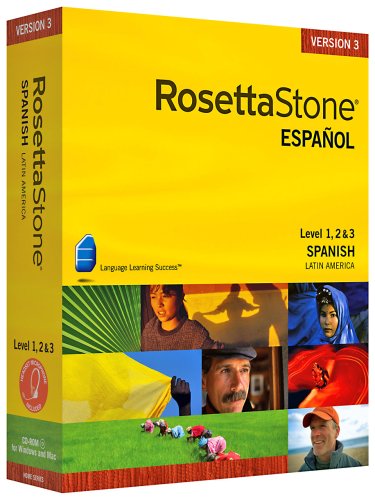
 Why is Rosetta Stone the world's No. 1 language-learning software? Because it works.
 Escape the endless tedium of translation, memorization, and grammar drills. Get the language you want, the skills you need and the success you deserve by learning a new language naturally--the same way you learned your first language.
You learned your first language without translation.
You learned your first language easily and naturally by connecting words to objects and events around you. With Rosetta Stone, learn a new language the same way: using native speakers and thousands of real-life images to help you think in the new language from the very beginning. Studies show that learning exclusively in the new language, without translation as a crutch, is crucial.
The exclusive Dynamic Immersion method reinforces your natural language-learning skills with award-winning instructional technology. Identify your learning goals, then choose customized courses that take you there.
 |  | |
 The complete immersion environment puts your native language-learning skills to work, eliminating your dependence on tedious translation and rote memorization. | | |
 |  |
| | |||
 Images Images |  |  Intuition Intuition | ||
| ||||
In Rosetta Stone you learn the meaning of new language from clear, real-life images.
In this activity you learn colors. | | You advance using language you've learned and clues from new images. That's your intuition at work.
Now that you know colors, you can easily grasp the meaning of the new words... | ||
| ||||
 Interactivity Interactivity | |  Instruction Instruction | ||
Throughout Rosetta Stone, you constantly interact with the program to confirm your intuition.
...and then check what you've learned. | | From beginning to end you build systematically toward your language-learning goals, for the most effective and enjoyable instruction anywhere.
And finally, you get the fun of trying your new language in a real-life simulation. Speech recognition shows you exactly how you're doing. | ||
| | |||


The timeless immersion method, along with research-based techniques and new technologies, make Rosetta Stone the clear solution to your language-learning needs.
What will you be able to do?
Understand everyday language.
Through Rosetta Stone's proficiency-based listening and reading activities, you'll learn quickly.
Pronounce words correctly.
After practicing with Rosetta Stone's speech recognition and analysis tools, pronunciation will come easily.
Speak without a script.
Contextual Formation makes sure you have the confidence and cues you need to get the words out on the spot.
Spell and write accurately.
You'll build gradually from letters to words and sentences.
Engage in real-life conversations.
With Milestone activities, gain confidence using speech alone in simulated situations.
Retain what you learn.
The unique Adaptive Recall reinforces language so it sticks with you in the real world.
Customer Review: Rosetta Stone V3-Spanish (Latin America) Level 1,2,3
I purchased this for my college-aged daughter so that she could become proficient in Spanish. This has given her the practice she needs that the classroom (high school) did not.
Customer Review: Great Addition to School Learned Spanish
I took 17 hours of Spanish during my undergraduate degree, but could not speak Spanish. I could read Spanish, but I could not understand it when spoken. Rosetta Stone takes a different approach to teaching Spanish than my university. It has made understanding and speaking Spanish within my reach. I had a strong vocabulary base, but Rosetta Stone has helped me to be able to speak and use this vocabulary in everyday conversation. This is a great complement to any Spanish curriculum. It is a wonderful option for those who couldn't learn Spanish "the old fashion way."
Ringtones are big business. The Yankee Group announced that over the last five years, these musical tones have sent people literally singing to the bank, with a total revenue of $2 billion since 2001, and $50 million in one year alone.
The figures show how popular ringtones have become among cell phone users, who download the files to personalize their caller functions. They can pick from millions of songs, from the latest hit R&B single, to quirky sounds like cows mooing, to the classical pieces of Ludwig van Beethoven. Technological development has also made the audio quality of the ringtones much more realistic. From the ear-piercing, tin-like sounds of the first downloadable tunes, todays music pieces have a near-radio quality. You could dance to it, except youd look pretty silly shaking your booty while taking a call.
Unfortunately, the realistic quality of the musical pieces have raised a few ethical issues, namely violation of copyright. Since the sound of the ringtones and the sound of the actual songs are so close, record companies are saying that they count as reproductionsand because of that, they should pay some kind of royalty to the labels and the singers.
In a celebrated case, rap artist Eminem filed injunctions against five ringtone companies, supposedly because they had used his songs without his prior consent.
Some would argue that the ringtones only use ten seconds, maximum, of the actual song. How long should a snippet be before it becomes copyright infringement? Nokia representative Matthew Courtney believes that it has nothing to do with length. "Every reproduction of a musical excerpt involves payment of copyright fees to the copyright owner," he says.
There are some songs that fall beyond this rule, such as those that fall into public domain: classical pieces, national anthems, and yes, a cow mooing. (To date, there are no records of cows suing any major ringtone company.) Others still require the permission of the artists, and may even be subject to royalty fees.
Luckily most artists are not that inclined to sue, seeing the ringtones as a way of promoting their music, and perhaps a compliment to their own popularity. In a way, being immortalized in a ringtone has become a gauge of how ones music has infiltrated public consciousness. Besides, nobody actually downloads a ringtone as a replacement for an actual record. A real fan would want more than a ten second recording out of a three minute song, although would probably use that snippet to announce to the world, Hey, this tune rocks.
However, trends do indicate that fans may actually be willing to pay for their polyphonic ringtones. Music label EMI representative Jay Samit estimates that the earnings form ringtones could contribute as much as 10% of the record industrys total revenues. Apparently, the appeal of ringtones is that strong people arent just downloading it because its free, but because its a valued feature.
Of course, many polyphonic ringtones still allow people to download the tunes for free, generating their revenue from ads instead. Others use a mixture of the two business models, offering some for free (or a weekly rotating list) while requiring a small download fee for premium ringtones.
Either way, lawsuits notwithstanding, the fact is that ringtones are here to stay.
Polyphonics.eu.com provides fully licensed polyphonic ringtones as well as all the latest real tones.
dance music 2007
No comments:
Post a Comment