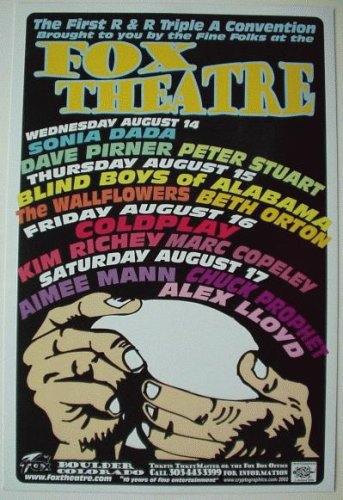
 Original concert poster for Coldplay / Wallflowers / Aimee Mann / Beth Orton / Sonia Dada / Chuck Prophet / Kim Richey etc at the Fox in Boulder, CO. 13x19 card stock. Art by Jeff Holland.
Almost everyone would agree that the most common question that dancers ask potential partners at swing club functions is: "would you like to dance?" This straightforward question is asked hundreds of times an evening and usually, after a brief conversation, the smiling couple walks to the dance floor where the "leader" leads and the "follower" follows. It is understood that when the male dancer determines which moves are the most appropriate to lead his partner, he must factor in her experience level, the tempo of the music and the space available to him on the dance floor; however, there is another implied, yet unspoken, consideration that makes his selection even more challenging, and surprisingly, it is not for his lack of taking sufficient dance lessons!
When the D.J. begins spinning, most dancers around the room move effortlessly into their patterns, but for one leader this moment is "crunch time" because at the last second, just before he transitions his partner into the open position with his planned "Tuck and Turn," she urgently mentions her bad rotator cuff and asks him not to raise her right arm above her head. Whew, the male dancer thinks, I knew there was a reason that the clubs always teach the "Glideaway!" Having successfully dodged that bullet and moved his partner into the open position, he decides to lead her into a neck wrap using either a traditional, two-hand tuck entry, or a modified "Sweetheart Wrap" entry where, before he turns her, he may circle his left hand (holding her right hand) in front of her head at neck level to minimize any stress on her right shoulder. Great idea he muses as he opts for the latter entry; however, his self-congratulations are short lived because after he picks up a two-hand lead and he begins to rotate her around clockwise into the wrap, his partner balks at his lead and informs him that she recently sprained her neck and to please be gentle.
Without missing a beat the male dancer deftly continues around behind her and exits the move holding her right hand again in the open position. While executing a couple of "patty-cakes" to contemplate his next move, our hero suspects that his partner is protective of her left wrist which she casually confirms moments later by telling him about her recent diagnosis of carpal tunnel, caused by her long hours at work as a computer programmer. "I'd rather dance than work any day wouldn't you?" she asks cheerfully. "It's great exercise and it really increases your range of movement!" He agrees and compliments his partner on her great footwork and enthusiasm, and then he leads her into a benign, waist level pass-by which worked great; that is, great until her casual reference to the knee that she twisted recently playing volleyball and her not so subtle request for him to avoid leading her into moves like the 'last one' that caused her to lean forward which aggravates the pain in her lower back.
Wanting very much for his partner to enjoy their dance and being sensitive to her temporary physical limitations, the male dancer decides that it is time for him to really play it safe, so he leads her into a comfortable "Basic Return" followed by a "Caught-in-the-Cage." Both of these moves worked perfectly: when he led her return into the closed position, her right hand was positioned at waist level, and when he rotated her back-and-forth within her "cage" she was able to stand up straight. The male dancer executed a few more carefully considered moves and then he led his partner back into the closed position feeling confident that he had protected her as much as possible from any pain. After he quickly dismissed the thought that his hand "flip-flopping" on her upper back during the "Caught-in-the-Cage" would have any impact whatsoever on her lower back pain, he smiled and instinctively knew at that moment that he was improving as a dancer by becoming a better leader!
As the music ended, the male dancer avoided any concluding embellishments like a "dip" and he simply led his partner into their final steps together in the closed position. Afterwards, she graciously thanked him for the wonderful dance and, while they threaded their way across the crowded floor towards her table, he reflected upon the valuable lesson their dance had taught him. He used to think that music tempo and dance floor space coupled with his partner's experience determined which swing moves to lead, now he realized that he also needed to consider their physiological impact. When he seated her, she asked him what he thought of her favorite line dances: the Electric Slide and Swamp Thing. Ordinarily, he would be very unenthusiastic about these two dances; however, live and learn! Grateful for his new insights from their enjoyable dance together, he looked at her with appreciation and then he surprised himself by answering her question without even a blink of an eye: "I haven't learned these popular dances yet but they certainly look like a lot of fun. I'll bet they really give you that welcome freedom of unrestrained movement and expression don't they!"
Copyright 2008 by Skip Culver, Certified Swing Dance Instructor. Member of the West Count Swing Dance Club and author of the manual: Imperial Swing Dancing - visit: http://www.ImperialSwing.com
Henry H. "Skip" Culver, Jr. is a member of the West County Swing Dance Club in St. Louis Missouri. He is a Gold Seal Instrument Flight Instructor and the author of the bestselling book on navigation titled: IFR 'Pocket Simulator' Procedures that was selected as the Main Selection of the Jeppesen Aviation Book Club. In 2000 Skip turned his attention from flying towards the dance floor. He became a Certified Swing Dance Instructor in 2004, and then with over seven years of detailed notes from various classes and workshops in hand, he began assembling the Imperial Swing Dancing manual which he published in June of 2007. Skip is a frequent contributor of articles on swing dancing to different club newsletters throughout the United States.
dance music charts
No comments:
Post a Comment