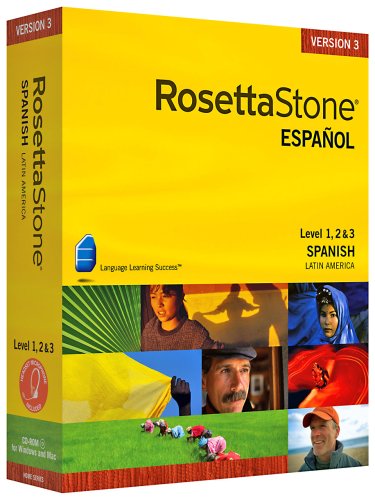
 Why is Rosetta Stone the world's No. 1 language-learning software? Because it works.
 Escape the endless tedium of translation, memorization, and grammar drills. Get the language you want, the skills you need and the success you deserve by learning a new language naturally--the same way you learned your first language.
You learned your first language without translation.
You learned your first language easily and naturally by connecting words to objects and events around you. With Rosetta Stone, learn a new language the same way: using native speakers and thousands of real-life images to help you think in the new language from the very beginning. Studies show that learning exclusively in the new language, without translation as a crutch, is crucial.
The exclusive Dynamic Immersion method reinforces your natural language-learning skills with award-winning instructional technology. Identify your learning goals, then choose customized courses that take you there.
 |  | |
 The complete immersion environment puts your native language-learning skills to work, eliminating your dependence on tedious translation and rote memorization. | | |
 |  |
| | |||
 Images Images |  |  Intuition Intuition | ||
| ||||
In Rosetta Stone you learn the meaning of new language from clear, real-life images.
In this activity you learn colors. | | You advance using language you've learned and clues from new images. That's your intuition at work.
Now that you know colors, you can easily grasp the meaning of the new words... | ||
| ||||
 Interactivity Interactivity | |  Instruction Instruction | ||
Throughout Rosetta Stone, you constantly interact with the program to confirm your intuition.
...and then check what you've learned. | | From beginning to end you build systematically toward your language-learning goals, for the most effective and enjoyable instruction anywhere.
And finally, you get the fun of trying your new language in a real-life simulation. Speech recognition shows you exactly how you're doing. | ||
| | |||


The timeless immersion method, along with research-based techniques and new technologies, make Rosetta Stone the clear solution to your language-learning needs.
What will you be able to do?
Understand everyday language.
Through Rosetta Stone's proficiency-based listening and reading activities, you'll learn quickly.
Pronounce words correctly.
After practicing with Rosetta Stone's speech recognition and analysis tools, pronunciation will come easily.
Speak without a script.
Contextual Formation makes sure you have the confidence and cues you need to get the words out on the spot.
Spell and write accurately.
You'll build gradually from letters to words and sentences.
Engage in real-life conversations.
With Milestone activities, gain confidence using speech alone in simulated situations.
Retain what you learn.
The unique Adaptive Recall reinforces language so it sticks with you in the real world.
Customer Review: Rosetta Stone V3-Spanish (Latin America) Level 1,2,3
I purchased this for my college-aged daughter so that she could become proficient in Spanish. This has given her the practice she needs that the classroom (high school) did not.
Customer Review: Great Addition to School Learned Spanish
I took 17 hours of Spanish during my undergraduate degree, but could not speak Spanish. I could read Spanish, but I could not understand it when spoken. Rosetta Stone takes a different approach to teaching Spanish than my university. It has made understanding and speaking Spanish within my reach. I had a strong vocabulary base, but Rosetta Stone has helped me to be able to speak and use this vocabulary in everyday conversation. This is a great complement to any Spanish curriculum. It is a wonderful option for those who couldn't learn Spanish "the old fashion way."
Dance has been an important part of rituals, celebrations and entertainment since before the birth of human civilisation. In the beginning, before we had written language to record things, the purpose of dance was often to tell stories and to pass them down to future generations.
The story of dancing in Cuba
In Cuba, as in ancient times, dance tells its own story. The passion and energy of Cuban dance reveals the strength and conviction of the Cuban people, determined to enjoy life despite 'la lucha' (the struggle) of living in a strictly regulated country where the average monthly wage comes in at around 400 pesos - less than 10.
The richness of Cuban music and dancing also tells the story of Cuba's melting pot of cultures. From the high-stepping flamenco brought by the Spanish settlers in the 15th century to the frenzied tribal dances of the West African slaves, dancing is in the blood of the Cuban people.
From the teenage girl in denim shorts to the cigar-seller on the street corner, Cubans are given to break into spontaneous dance steps. Furthermore, the people dancing on the streets of Havana are likely to be just as good as the professionals, because in Cuba dancing is simply a way of life.
The variety of Cuban dances
Cuba boasts a huge range of dances including classical ballet, contemporary, flamenco and folk dancing. But it is the partnered routines that appeared in Havana dancehalls between the 1920s and the 1950s - Salsa, rumba, mambo and cha-cha-cha - that can be seen in every Cuban bar, club and street. Of these, Salsa is the most popular dance internationally.
Since the name 'Salsa' (it's Spanish for 'sauce') was coined, Salsa dancing has exploded in popularity in Latin America and across the world. Salsa dancing classes are now hugely popular but to really get into the swing of it a Salsa holiday in Cuba itself is a must.
Tips for Cuban Salsa dancing
If you do take yourself on a Cuban holiday, you'll have the unique experience of watching Cubans Salsa dancing. It sometimes appears that by some genetic aberration they have been born with super flexible joints, defying physics to carry out all the complex manoeuvres they have integrated into the dancing. Their remarkable twisting body movements and natural sense of rhythm will dazzle you.
If you have the right technique, Cuban Salsa is easier to learn than many other forms of dance. The basic footwork is a fairly simple walking motion, pausing every fourth beat, and there are some six basic steps you can follow to make sure you're on the right tracks.
1 Relax
To dance Cuban Salsa well it is important not to rush, but to relax into the steps. Movements should be precise and deliberate in addition to being flowing and smooth.
2 Walk with purpose
Salsa dancing involves a continual circular motion. Couples walk around each other with an imaginary axis between them. This makes turns look smooth and effortless. Walking gives time to untangle your arms after each turn.
3 Have confidence in your lead
The leader (usually the man) should have constant tension in his arms, while his hands guide his Salsa dancing partner around the floor. There is no need to clamp onto each other's hands, only to use the right amount of tension to provide a leading signal.
4 Be flexible when following
In order to follow well, ladies should try to match the tension of their partner. The exception to this is when arms need to be relaxed and flexible to complete arm-twisting Salsa moves without injury!
5 Keep balanced when you spin
The key to all the spectacular spins in Salsa is not to lose your balance. One way to do it is by spotting while you spin - focussing on one spot at each turn - an age-old dance technique.
6 Use your body
In Salsa dancing, ladies should make use of their body and be sensual, playful and creative. This can involve some creative arm movements, going with what feels right and basically showing off a bit. Enjoy!
Emma Lelliott is the general manager of Captivating Cuba, an independent Cuba holiday specialist. With offices in Havana and the UK, Captivating Cuba can offer Cuban Salsa holidays to Havana as well as expert advice on holidays to Varadero and Cayo Coco and lesser known resorts such as Jibacoa and Trinidad.
latin cds
No comments:
Post a Comment